
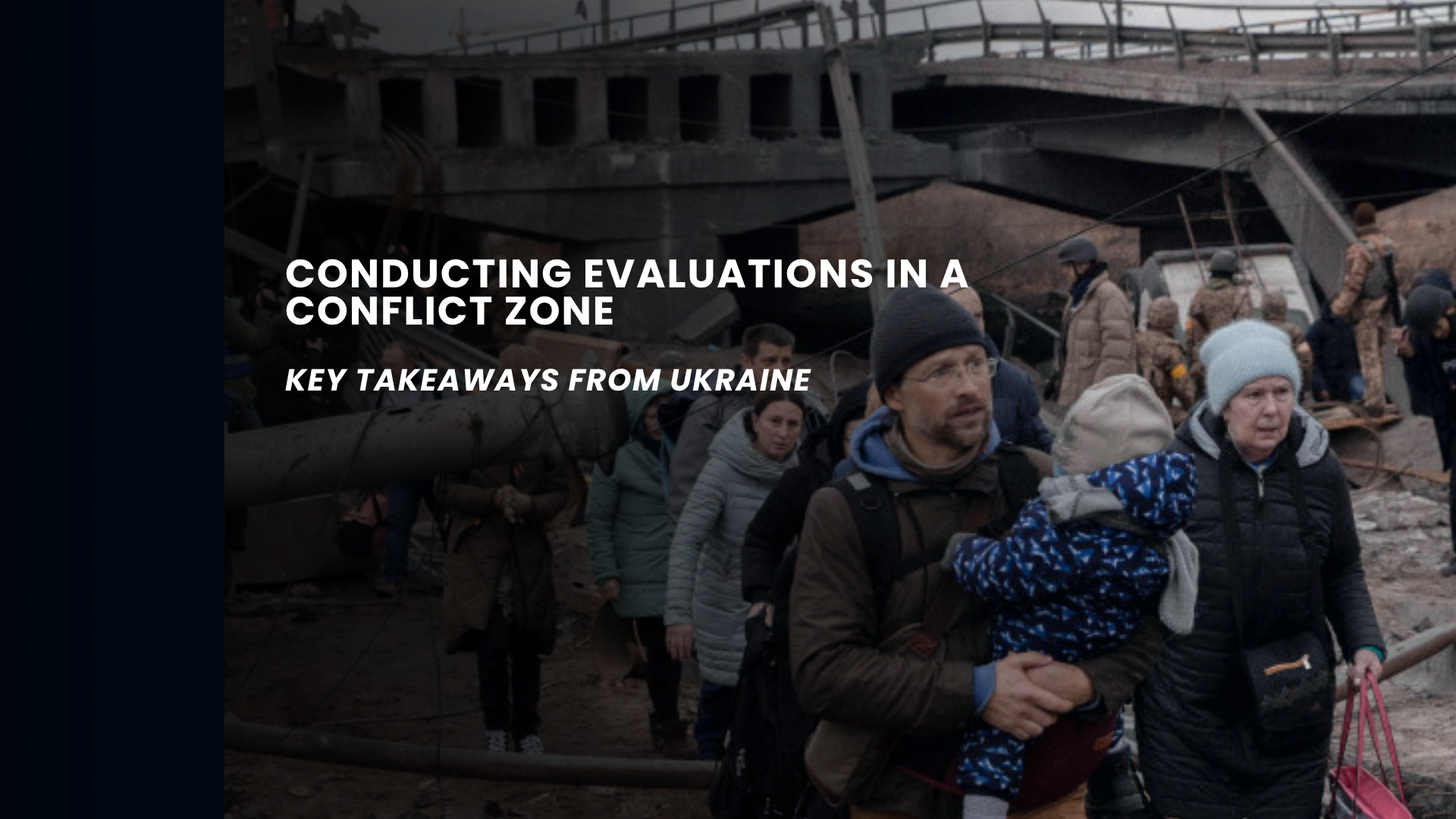
Conducting Evaluations in a Conflict Zone: Key Takeaways from Ukraine
Nino Kandelaki, Project Manager at DEPA Consulting
Research organisations and consultancy firms are increasingly conducting studies and evaluations in conflict-affected environments, driven by the need to strengthen support in these contexts and generate robust evidence to inform program improvement and decision-making. However, the unpredictability of such settings and the heightened vulnerability of affected populations require careful, flexible, and adaptive planning.
Drawing on DEPA Consulting’s experience in implementing several assessments and studies in Ukraine, we have observed that research design, field logistics, ethical considerations, security management, and participant well-being are deeply interlinked and continuously influence one another in real time. These experiences have underscored the importance of context-sensitive approaches, adaptive methodologies, and ongoing risk monitoring to safeguard both the quality of evidence and the safety, dignity and well-being of participants and research teams.
The following reflections are based on data collection conducted in Ukraine under conditions of active hostilities and examine the practical challenges of implementing research that combined key informant interviews, focus group discussions, surveys, observations, and case studies across diverse stakeholder groups. They highlight the operational, ethical, and methodological complexities encountered in highly volatile environments and aim to provide practical insights for scholars, evaluators, and operational teams working in similar complex and conflict-affected contexts.
Logistical and Mobility Constraints
One of the most underappreciated dimensions of conflict-sensitive research is logistical access and mobility constraints for international experts. Securing appropriate insurance coverage for personnel operating in Ukraine proves unexpectedly complex. Several international insurance providers have withdrawn or significantly modified coverage conditions due to the active conflict environment. In practice, this requires direct engagement with multiple providers to identify one willing to insure field travel. Even when available, costs are significantly higher, with weekly packages reaching around USD 800 or more, depending on risk classification and timing.
Mobility itself is equally constrained. With commercial flights unavailable due to the active war zone, international experts rely on overland travel through neighbouring countries, e.g., entering from Poland and continuing by train or car to the city before onward travel within Ukraine. Domestic movement, while still possible, is shaped by curfews and transport availability and requires careful coordination with schedules that are themselves subject to disruption. Accommodation arrangements are subject to prior security clearance, based on applicable safety standards for accommodation providers in high-risk settings and in line with organizational risk management and security protocols.
These logistical realities significantly expand the scope of what “fieldwork preparation” actually entails, as it includes insurance procurement, careful route planning, selecting safe accommodation, compliance with war-zone restrictions, etc. In effect, logistical planning becomes an integral part of research design rather than a separate operational layer.
Data Collection Under Persistent Security Disruption
A central and immediate reality of working in such a context is that security conditions are not an external variable; they constitute the operating environment itself. In certain oblasts, frequent air raid alerts, missile and drone strikes, and shelling directly disrupt planned activities, often multiple times within a single day. These disruptions are a recurring reality of the fieldwork operations. As a result, scheduling is never fixed in a conventional sense; instead, it becomes a process of continuous adjustment, frequently requiring rapid transitions between in-person, remote, and hybrid modalities. Even when interviews proceed as planned, the constant possibility of interruption shapes both respondents’ engagement and the pace of data collection. Participants may remain cautious, distracted, or emotionally tense due to the surrounding security situation, which can affect the depth, openness, and consistency of responses. As a result, these conditions influence not only the efficiency of data collection, but also the overall quality and reliability of the evidence gathered.
Operational and Technical Disruptions
At the same time, technical constraints shape what is possible on the ground. Weak mobile coverage and unstable internet connections affect coordination and data transmission, often limiting communication and delaying operational processes. Fieldwork schedules also undergo repeated adjustments due to last-minute changes in programme activities, emergency deployments of local partners, or the shifting availability of institutional stakeholders.
Psychological and Ethical Dimensions
Closely connected to this is the psychological burden experienced by both respondents and research teams. Interviews often touch upon sensitive and traumatic experiences and their continuing impacts. In some cases, participants display visible emotional distress, including anxiety. This creates a continuous ethical tension between the depth of inquiry and the principle of “do no harm.” In practice, safeguarding participant well-being necessarily takes precedence over methodological completeness. Trauma-informed interviewing approaches, shorter or paused sessions, and careful moderation of probing therefore become essential tools.
Methodological Adaptation
However, what is often less visible in standard methodological reporting is the extent to which such designs depend on flexibility rather than strict sequencing. Methods are not simply implemented; they are continuously recalibrated. This includes modifying interview formats, integrating remote data collection when travel is not feasible, and simplifying tools to accommodate cognitive or emotional strain among respondents.
Synthesis and Lessons Learned
Taken together, these experiences highlight a broader lesson for research and evaluation in conflict settings: rigour is not only methodological, it is adaptive. Maintaining data quality under conditions of instability and unsafety requires more than predefined protocols; it requires continuous judgment calls regarding safety, ethics, and feasibility. These decisions involve balancing priorities, including when to prioritize participant well-being over depth, when to accept data limitations, and when to redesign fieldwork strategies in response to evolving realities. Ultimately, this reflects an operating environment in which uncertainty is constant and adaptability becomes a core methodological principle.